


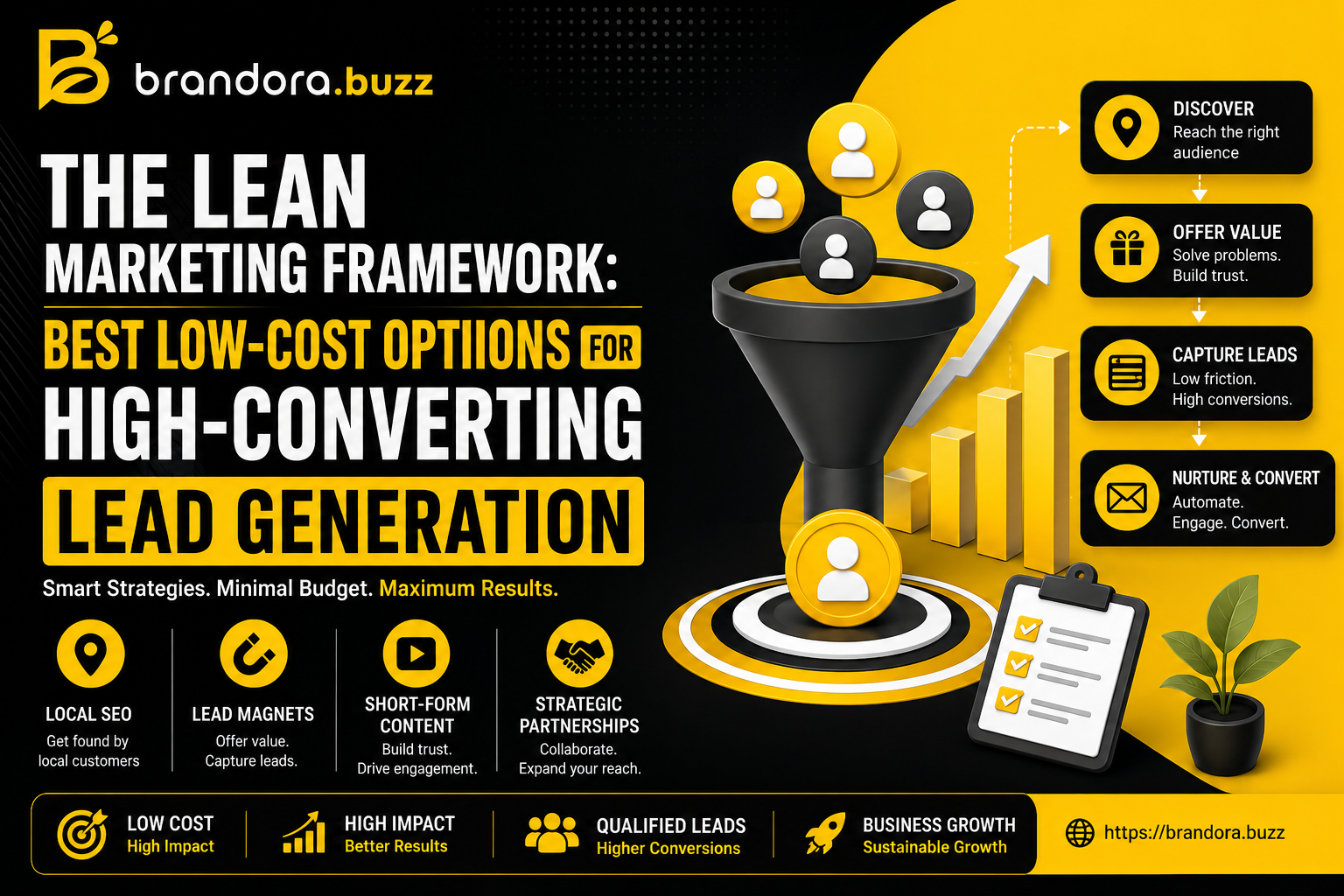
For a small business, marketing is often treated like a spending contest.
The company with the largest advertising budget buys the most impressions. The brand with the biggest content team publishes the most frequently. The business with the largest social following appears to have the most momentum.
But impressions do not pay invoices. Followers do not automatically become customers. And a viral post can produce less revenue than a handful of highly relevant prospects.
For small businesses, startups, and independent entrepreneurs, the better question is:
How can we consistently generate qualified business leads without spending heavily on advertising?
That is the purpose of a lean marketing framework: creating a practical digital marketing strategy that turns limited resources into consistent business opportunities.
Lean marketing does not mean doing marketing without effort or investment. It means deliberately trading time, expertise, relationships, creativity, and consistency for distribution that larger competitors often purchase with advertising budgets.
The goal is not to be everywhere.
The goal is to build a repeatable system that moves a potential customer through this journey:
Problem → Discovery → Value → Trust → Contact → Conversation → Customer
And the most important principle in that system is simple:
Give a prospect a small, immediate win before asking for a large commitment.
The Shift From “Likes” to Leads
Many small businesses measure marketing using metrics that feel positive but do not necessarily produce revenue:
- Impressions
- Followers
- Likes
- Video views
- Reach
- Website traffic
These metrics are not useless. They can help measure awareness and brand exposure.
But they are often distance metrics. They tell you how many people saw something—not how many people are now closer to becoming customers.
A lead, by contrast, represents an actual commercial opportunity.
A qualified lead may:
- Request a quote
- Book a consultation
- Submit an inquiry
- Download a useful resource
- Request an audit
- Start a conversation
- Join a relevant email list
That is why a small business should ask:
What action do we want a potential customer to take after discovering us?
A business may receive 100,000 social media impressions and generate zero inquiries.
Another business may receive 500 highly relevant visitors from search, community engagement, or a referral partnership and generate 20 genuine sales conversations.
For most small businesses, the second outcome is significantly more valuable.
This is why a focused digital marketing strategy should be designed around commercial intent—not simply attention.
The Value First Principle
The most effective low-cost marketing often begins by solving a small problem for free.
A web designer could offer:
- A free website speed checklist
- A homepage conversion audit
- A mobile usability review
An accountant could provide:
- A small-business tax deadline checklist
- A cash-flow calculator
- A bookkeeping readiness audit
A marketing agency could provide:
- A local SEO audit template
- A Google Business Profile checklist
- A lead-generation scorecard
The prospect receives something useful before they are asked to buy.
That changes the psychological relationship.
Instead of saying:
“Trust us. We are experts.”
You demonstrate:
“We understand your problem, and we can already help you solve part of it.”
That is powerful because proof of competence is usually more persuasive than a claim of competence.
Lean marketing rule: Don’t ask for a sales conversation before creating a reason for the prospect to value the conversation.
The Low-Cost Channel Matrix
Different channels produce different types of returns. The best option depends on your market, location, sales cycle, and ability to create useful content.
| Channel | Approximate Cash Cost | Why It Works for Lead Generation |
|---|---|---|
| Local SEO & Google Maps | $0 to minimal | Captures people actively searching for a service or business |
| Micro-Incentive Lead Magnets | $0 to minimal | Exchanges immediate utility for contact information |
| Organic Short-Form Video | $0 to minimal | Demonstrates expertise and reaches new audiences without ad spend |
| Strategic B2B & Local Directories | $0 to minimal | Places your business where prospects already search for providers |
| Community Engagement | $0 | Builds trust by answering specific questions in high-intent communities |
| Cross-Promotional Partnerships | $0 | Borrows the attention and trust of complementary businesses |
| Email Marketing | $0 to minimal | Converts existing attention into repeatable communication |
The key is not to activate every channel at once.
A lean business should usually choose:
- One discovery channel
- One value asset
- One conversion mechanism
- One follow-up system
That is enough to build a functional lead-generation engine.
Deep-Dive Tactical Blueprint #1: Hyper-Local Search
For local businesses, Google Search and Maps can be one of the highest-intent sources of leads available.
Someone searching:
“emergency plumber near me”
is fundamentally different from someone casually watching a plumbing video.
The searcher already has a problem.
Your job is to make your business:
- Visible
- Credible
- Easy to contact
This is where a properly executed local SEO strategy becomes a powerful low-cost customer acquisition channel.
Step 1: Fully Optimize Your Google Business Profile
Your Google Business Profile should be treated as a digital storefront.
Complete every relevant field:
- Business name
- Primary category
- Secondary categories
- Address or service area
- Phone number
- Website
- Opening hours
- Services
- Products
- Business description
- Photos
The primary category is particularly important because it helps Google understand the central nature of the business.
Do not randomly add categories simply because they seem attractive.
Choose categories that accurately represent your core offering.
Google provides official guidance for managing business information through its Google Business Profile platform, which should be the primary reference when setting up and maintaining a local business listing.
Step 2: Create Service-Specific Content
Many businesses make the mistake of having one generic page called:
“Our Services”
Instead, create pages that match actual customer searches.
For example:
- Emergency Plumbing
- Bathroom Renovation
- Commercial Plumbing
- Water Heater Repair
Each page should clearly explain:
- The problem
- The service
- Who it is for
- The process
- Service area
- Frequently asked questions
- How to contact the business
These pages should not simply repeat the same text with different keywords.
Each page should address a distinct customer need.
A well-structured business website can turn search visibility into actual inquiries by making the next step obvious.
Step 3: Use Local Schema Markup
Structured data can help search engines better understand key business information.
Depending on the business, relevant schema may include:
LocalBusinessOrganizationServiceFAQPageBreadcrumbList
Include accurate information such as:
- Business name
- Address
- Phone number
- Opening hours
- Website
- Service area
For implementation guidance, Google’s official documentation on LocalBusiness structured data is an excellent reference.
You can also consult the official LocalBusiness vocabulary on Schema.org.
Schema is not a magic ranking button.
Its real value is helping search engines interpret your business more accurately.
Step 4: Build a QR-Code Review System
Customer reviews are one of the most valuable forms of local trust.
Create a simple process:
Customer completes service → receives thank-you message → scans QR code → lands on review page
Place the QR code on:
- Receipts
- Packaging
- Business cards
- Invoices
- Counter displays
- Thank-you cards
The message should be simple:
Happy with our service? Scan to share your experience.
Do not pressure customers to leave only positive reviews. Google review policies
The objective is to make it easy for satisfied customers to provide genuine feedback.
Better implementation
Create separate QR codes for different locations or campaigns.
For example:
- QR code on receipt
- QR code on packaging
- QR code in follow-up email
This allows you to understand which touchpoints generate the most review activity.
Always follow Google’s review policies and avoid manipulating customer feedback.
Deep-Dive Tactical Blueprint #2: Micro-Incentive Lead Magnets
The traditional lead magnet is often a 40-page ebook.
The problem?
Most people do not want another ebook.
They want an answer.
They want a calculation.
They want to know what to fix next.
That is why small, interactive assets can outperform long-form downloads.
Examples of High-Utility Lead Magnets
For an SEO agency
- Free SEO audit template
- Local SEO checklist
- Website visibility scorecard
- Keyword opportunity calculator
For a financial consultant
- Monthly cash-flow calculator
- Business expense checklist
- Break-even calculator
For a web designer
- Homepage conversion checklist
- Website launch checklist
- Website cost calculator
For a marketing agency
- Lead-generation scorecard
- Social media audit template
- Marketing budget calculator
The asset should answer:
What can the prospect use within the next 10 minutes?
Step 1: Identify One Painful Question
Do not create a resource about everything.
Choose one problem.
For example:
“Why is my website getting traffic but no leads?”
That question is specific enough to create a useful resource around.
Step 2: Create the Simplest Useful Tool
This could be:
- A calculator
- A checklist
- A scorecard
- A template
- An audit
- A decision tree
The goal is not to create the most sophisticated tool possible.
The goal is to create the most useful tool that solves a specific problem quickly.
Step 3: Put It Behind a Low-Friction Form
Ask only for information you genuinely need.
For a downloadable checklist, the form might require:
- First name
- Email address
For a business audit, you may also ask:
- Website URL
- Business type
Do not ask for:
- Full address
- Company size
- Phone number
- Job title
- Budget
- Five qualification questions
unless there is a legitimate reason.
Every unnecessary form field creates another opportunity for abandonment.
A lean lead-generation system should optimize for the first conversion—not collect a complete customer profile before the relationship has even started.
Step 4: Deliver the Asset Immediately
After submission:
- Show a thank-you page
- Provide immediate access
- Send the asset by email
- Offer one relevant next step
The prospect should receive value within seconds.
Deep-Dive Tactical Blueprint #3: Audience Borrowing
You do not always need to build an audience from zero.
Sometimes the fastest path to qualified prospects is to participate in communities and relationships that already exist.
This is audience borrowing.
The ethical version is not spam.
It is not:
Join a group → drop your link → disappear.
It is:
Find a community with a problem → contribute genuinely useful expertise → become recognized as helpful → earn attention naturally.
Reddit, Quora, and Niche Forums
The process is simple.
Step 1: Find Recurring Questions
Search for questions that:
- Appear repeatedly
- Have poor existing answers
- Represent a genuine business problem
- Match your expertise
For example, a web development agency may find recurring questions about:
- Website costs
- Poor conversion rates
- Website speed
- Choosing a CMS
- Local business websites
A marketing consultant may find questions about:
- Lead generation
- Marketing budgets
- SEO
- Advertising
- Customer acquisition
Step 2: Write the Best Answer You Can
Do not write:
“Contact us for help.”
Instead, explain:
- What the person should check
- What the common mistake is
- What steps to take
- What tools or processes may help
Your objective is to create a useful answer even if the reader never becomes a customer.
Step 3: Link Only When Genuinely Useful
If your website contains a detailed calculator, checklist, or guide that directly expands on your answer, link to it naturally.
Your goal is not to extract clicks from every answer.
Your goal is to build a reputation for usefulness.
That reputation can lead to:
- Direct messages
- Referral traffic
- Brand searches
- Consultation requests
- Organic recommendations
The most important rule is simple:
Participate in the community before attempting to monetize the community.
Zero-Dollar B2B Cross-Promotion
A small business may have limited reach.
But a complementary business may already have the exact audience you need.
For example:
- A web designer + photographer
- A wedding planner + florist
- An accountant + business consultant
- A gym + nutrition coach
- A real estate agent + mortgage advisor
These businesses are not necessarily competitors.
They serve overlapping audiences.
Step 1: Identify Complementary Businesses
Find businesses that:
- Serve the same target market
- Do not directly compete with you
- Have an email list, customer base, or community
- Offer a service that complements yours
Step 2: Create a Mutual-Value Offer
Examples:
- Joint checklist
- Co-hosted webinar
- Referral arrangement
- Joint email newsletter
- Combined discount
- Educational workshop
Step 3: Make the Proposal Specific
Weak:
“Would you like to collaborate?”
Better:
“I noticed we both work with small local businesses. I created a short checklist on improving online visibility. Would you be interested in sending it to your audience if I create a companion guide for your customers?”
Specific proposals are easier to evaluate.
Step 4: Exchange Value—Not Just Promotion
The best partnerships are not:
“You promote me, and I promote you.”
They are:
“We create something useful for the same audience, and both businesses become more valuable.”
This is a zero-dollar growth strategy that can create access to highly relevant audiences without buying advertising.
Strategic B2B and Local Directories
Directories are often dismissed because many low-quality directories have little value.
That does not mean all directories are useless.
The important distinction is between:
A directory that exists only to sell links
and:
A directory that customers actually use to find businesses.
Prioritize:
- Local chambers of commerce
- Industry associations
- Professional directories
- Local business directories
- Niche-specific platforms
- Trusted supplier directories
Before submitting your business, ask:
- Is this directory relevant to my audience?
- Can potential customers actually discover my business here?
- Is the listing maintained?
- Does the directory have a real purpose beyond SEO?
If the answer is yes, the listing may generate both visibility and referral traffic.
Organic Short-Form Video: Turn Expertise Into Discovery
Short-form video can be a low-cost discovery channel when it is built around customer problems.
Do not simply post:
“Here are our services.”
Instead, answer questions such as:
- Why is your website not generating leads?
- How much does a small business website cost?
- What should you check before running Google Ads?
- Why are your local competitors ranking above you?
- What is the biggest mistake businesses make with online marketing?
A simple video structure works well:
The 3-Part Short-Form Video Framework
1. Hook
“Your website may be losing leads for a reason you can fix in five minutes.”
2. Insight
Explain one specific problem and how to identify it.
3. Next step
Offer a relevant checklist, audit, or resource.
The video does not need to become viral.
It needs to attract the right person.
The Low-Friction Lead Funnel Workflow
A lean marketing system can be structured into four steps.
Step 1: Discovery
The prospect discovers you through:
- Google Maps
- Organic search
- Short-form video
- Quora
- A business partner
- A directory
- A referral
They encounter a problem-related asset.
Examples:
- “5 Reasons Your Website Is Not Generating Leads”
- “Free Local SEO Checklist”
- “Calculate Your Break-Even Point”
- “How Much Should a Small Business Spend on Marketing?”
The content should focus on a problem, not simply advertise your company.
Step 2: High-Value Landing Page
The prospect clicks through to a page that explains:
- The problem
- The benefit of the resource
- What they will receive
- Why it is useful
Avoid clutter.
The page should have one primary action.
For example:
Get the Free Website Conversion Checklist
Not:
- Download the checklist
- Book a call
- Read our blog
- Follow us on Instagram
- View our services
Too many choices create friction.
A strong landing page should make the next step obvious.
Step 3: Minimal Information Exchange
Ask for the minimum required information.
For many lead magnets:
First Name + Email Address
may be enough.
If the asset requires personalization:
Name + Email + Website URL
may be appropriate.
The goal is not to collect every possible data point.
The goal is to get the conversation started.
This is one of the most important conversion principles in low-cost lead generation:
Reduce the commitment required to receive the first piece of value.
Step 4: Automated Email Handshake
The first email should arrive immediately.
Email 1: Deliver the Value
Subject: Your Website Conversion Checklist
Here is the resource you requested. Start with Section 1 and identify the biggest conversion issue on your website.
Email 2: Add Context
Send after one or two days.
Explain:
- A common mistake
- A practical improvement
- A useful example
Email 3: Demonstrate Expertise
Share:
- A case study
- A before-and-after example
- A common industry mistake
Email 4: Offer the Next Step
The call to action should be low pressure:
“If you want help applying this to your business, you can request a free consultation.”
The email sequence should feel like a continuation of the value exchange—not an aggressive sales campaign.
The Lean Marketing Framework: Actionable Blueprint Checklist
Use this checklist as a practical operating system.
Discovery
- Choose one primary customer segment
- Identify the three problems they search for most frequently
- Select one primary discovery channel
- Optimize your Google Business Profile if you serve a local market
- Identify relevant directories and industry communities
- Create a list of complementary businesses for partnerships
Value Creation
- Choose one small but painful customer problem
- Create a checklist, calculator, audit, template, or tool
- Make the asset usable within 10 minutes
- Avoid creating a generic ebook unless the subject genuinely requires depth
- Create at least one short-form content asset that points toward the resource
Conversion
- Build one focused landing page
- Use one primary call to action
- Ask for the minimum information required
- Remove unnecessary form fields
- Make the benefit immediately obvious
- Deliver the promised resource instantly
Follow-Up
- Send an automated delivery email
- Send a second useful insight
- Demonstrate expertise with a case study or example
- Offer a low-friction next step
- Track leads, not just clicks
Local Growth
- Complete your Google Business Profile
- Create relevant service pages
- Implement appropriate local schema markup
- Build a simple QR-code review process
- Make it easy for satisfied customers to leave genuine feedback
Audience Borrowing
- Identify three relevant communities
- Answer questions consistently
- Avoid spammy self-promotion
- Find five complementary businesses
- Propose one specific cross-promotional idea
- Create a joint asset or educational opportunity
Final Thoughts: Lean Marketing Is a System, Not a Shortcut
Low-cost marketing does not mean effortless marketing.
You are replacing money with:
- Time
- Research
- Expertise
- Relationships
- Consistency
- Better execution
That is the trade.
But when executed correctly, the results can be significantly more durable than simply buying temporary attention.
The most effective lean marketing system usually follows this pattern:
Be discovered through a high-intent channel.
Solve a small problem immediately.
Make the next action extremely easy.
Ask for minimal information.
Continue delivering value after the lead converts.
The biggest mistake small businesses make is trying to generate leads before they have created a compelling reason for someone to respond.
The second biggest mistake is making the response process too complicated.
A prospect does not want to complete a 12-field interrogation to download a simple checklist.
They want the resource.
Give it to them.
Then earn the right to continue the conversation.
The lean marketing advantage is not that you spend nothing. It is that you spend your limited resources where they create the greatest amount of trust and commercial intent.
And in a world where attention is expensive, being genuinely useful remains one of the most affordable growth strategies available.
