


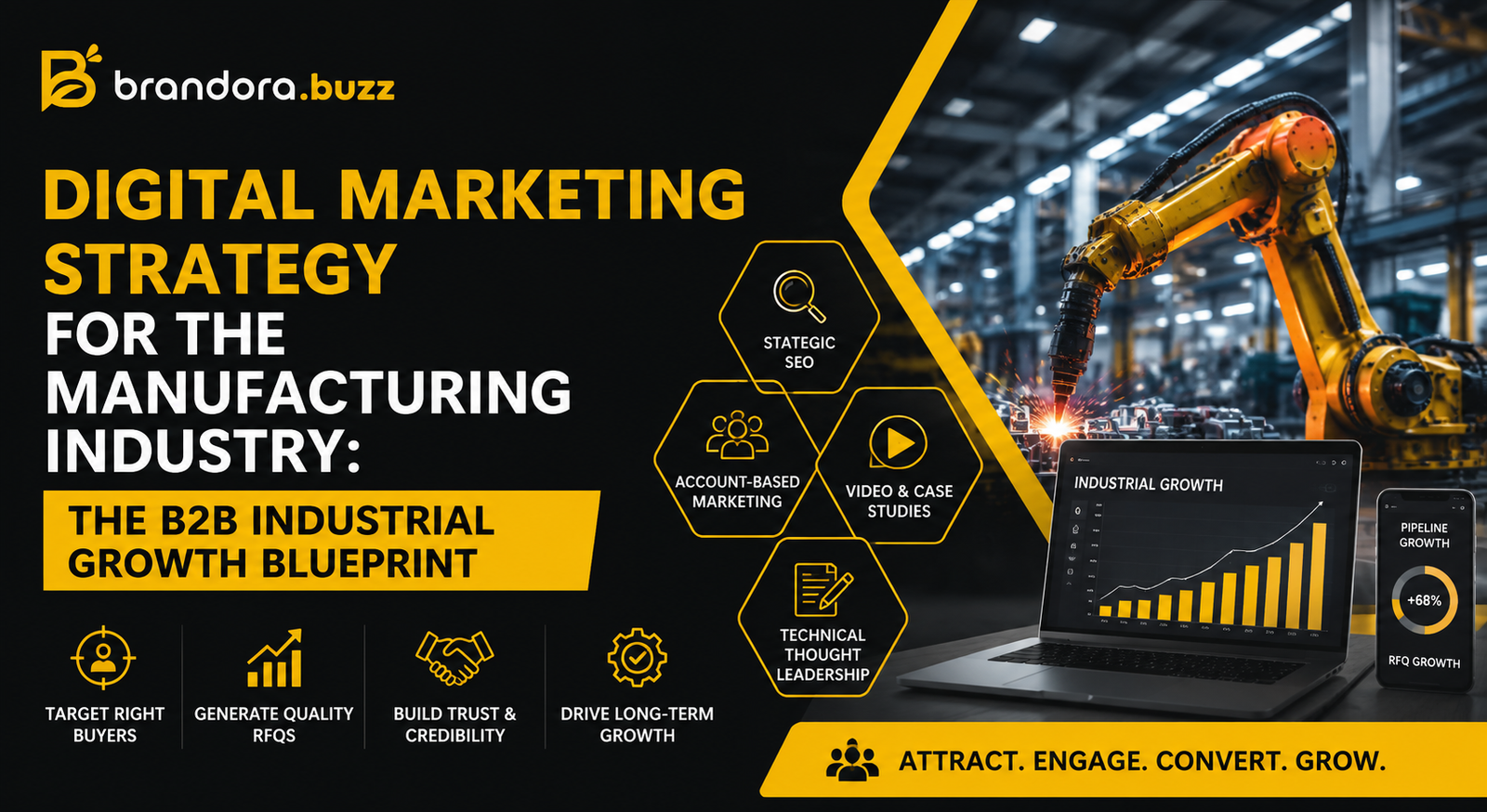
Industrial manufacturing has never been more competitive. Buyers now research suppliers long before requesting a quotation, compare technical capabilities across multiple vendors, and expect engineering-grade information before engaging with sales. Companies that still rely solely on trade shows, distributor networks, and cold outreach are gradually losing visibility to manufacturers that have invested in a modern digital marketing strategy.
Unlike consumer businesses, manufacturers rarely generate sales through impulse decisions. Purchasing industrial machinery, precision components, OEM assemblies, fabricated parts, or engineering services often involves contracts worth tens of thousands—or even millions—of dollars. The buying cycle typically lasts between 6 and 18 months, requiring multiple technical reviews, procurement approvals, and executive sign-offs.
The manufacturers winning today are those that position themselves as trusted technical partners rather than simply another supplier.
This blueprint explains how industrial companies can build a digital marketing system that consistently attracts qualified buyers, supports engineering teams, shortens sales cycles, and increases Request for Quote (RFQ) opportunities.
The B2B Manufacturing Reality Check
Many manufacturing companies attempt to copy marketing strategies from consumer brands.
They focus on:
- Posting daily social media updates
- Collecting likes and followers
- Running broad awareness advertisements
- Publishing generic company news
Unfortunately, these activities rarely influence industrial purchasing decisions.
A procurement manager isn’t selecting a CNC machining supplier because of Instagram engagement. An engineering manager isn’t approving a supplier because of entertaining TikTok videos.
Industrial purchasing decisions are based on:
- Engineering capability
- Production capacity
- Quality systems
- Technical documentation
- Delivery reliability
- Regulatory compliance
- Long-term business risk
Digital marketing must support these priorities.
Understanding the Industrial Decision-Making Unit (DMU)
Manufacturing purchases involve multiple stakeholders, commonly called the Decision-Making Unit (DMU).
Each stakeholder evaluates suppliers differently.
Engineers
Engineers want confidence that your solution works technically.
Their priorities include:
- CAD models
- STEP files
- Material specifications
- Tolerance information
- Surface finish data
- Testing documentation
- Engineering drawings
- Manufacturing processes
Marketing content should answer technical questions before engineers ask them.
Procurement Teams
Procurement evaluates commercial feasibility.
They care about:
- Pricing
- Minimum Order Quantities (MOQ)
- Lead times
- Payment terms
- Supplier reliability
- Production scalability
- Geographic location
- Supply chain stability
A website that hides lead-time information or complicates RFQ submission creates unnecessary friction.
Operations and Plant Managers
Operations teams focus on production reliability.
Their concerns include:
- Manufacturing capacity
- Automation
- Inventory management
- Delivery consistency
- Equipment redundancy
- Quality control systems
Showing production capability reduces operational risk.
Executive Leadership
Executives evaluate suppliers from a strategic perspective.
Their priorities include:
- Return on investment
- Business continuity
- Risk reduction
- Long-term partnerships
- Financial stability
- Innovation capability
Executive-focused messaging should emphasize measurable business outcomes instead of technical features alone.
Key Principle: Every page on your website should answer a different stakeholder’s questions instead of trying to convince everyone with the same message.
The Channel Strategy Matrix
| Channel | Primary Objective | Best Content Asset | Key Metric |
|---|---|---|---|
| Technical B2B SEO | Capture engineering search intent | Technical specification pages, application guides, CAD resources | Organic RFQs |
| LinkedIn B2B Marketing | Build credibility with decision-makers | Industry insights, engineering expertise, project highlights | Qualified engagement from target accounts |
| Account-Based Marketing (ABM) | Penetrate strategic OEM accounts | Personalized landing pages, engineering case studies | Meetings with target accounts |
| Video Facility Tours | Demonstrate manufacturing capability | CNC machining videos, automated production lines, cleanroom walkthroughs | RFQs influenced by video engagement |
The 4 Essential Pillars of Industrial Marketing
Pillar 1: Technical SEO & Intent Capture
Most manufacturers optimize for broad keywords like:
- CNC machining
- Metal fabrication
- Injection molding
These keywords attract mixed audiences and intense competition.
Industrial buyers search much more specifically.
Examples include:
- Stainless steel CNC machining ASTM A276
- ISO 13485 medical machining supplier
- Aluminum 6061 precision milling services
- Custom brass insert manufacturer
- Automotive stamping supplier ISO IATF 16949
- Aerospace titanium machining AS9100
These long-tail searches reveal strong purchase intent.
Optimize for Specification-Based Searches
Create dedicated landing pages around:
- Materials
- Manufacturing processes
- Certifications
- Industry applications
- Machine capabilities
- Part tolerances
- Surface treatments
Instead of one machining page, build pages for:
- 5-axis CNC machining
- Swiss machining
- Tight tolerance machining
- Medical machining
- Aerospace machining
- Prototype machining
- Production machining
Every page should answer technical questions thoroughly.
Turn CAD Files into Lead Magnets
Many engineers search for:
- STEP files
- SolidWorks models
- 3D CAD downloads
- Technical drawings
Instead of offering these resources without context, use them as high-value lead magnets.
Example gated assets include:
- STEP files
- CAD libraries
- Engineering handbooks
- Material comparison guides
- Tolerance charts
- Manufacturing design checklists
Keep forms short.
Only request:
- Name
- Company
- Business email
Avoid asking for excessive information during the first interaction.
Reduce RFQ Friction
One of the biggest conversion killers is an overly complex RFQ process.
Instead of requiring lengthy forms, allow visitors to:
- Upload drawings
- Attach CAD files
- Select manufacturing process
- Choose material
- Specify quantity
- Add comments
The faster buyers can submit an RFQ, the more opportunities your sales team receives.
Best Practices for RFQ Forms
- Accept multiple CAD formats
- Auto-confirm submissions instantly
- Display expected response times
- Enable mobile-friendly uploads
- Minimize mandatory fields
- Clearly explain confidentiality policies
Pillar 2: Account-Based Marketing (ABM) for Tier-1 Accounts
Manufacturers don’t need millions of visitors.
They need the right companies.
Account-Based Marketing focuses marketing resources on a carefully selected list of high-value prospects.
Instead of generating thousands of anonymous leads, ABM targets:
- OEMs
- Industrial distributors
- Defense contractors
- Medical device manufacturers
- Automotive suppliers
- Aerospace companies
Build a Tiered Target Account List
Segment accounts by strategic importance.
Tier 1
Highest-value accounts with long-term partnership potential.
Examples:
- Major OEMs
- Global manufacturers
- Enterprise industrial buyers
Highly personalized outreach is essential.
Tier 2
Regional manufacturers with recurring purchasing needs.
Marketing combines automation with personalization.
Tier 3
Broader industry opportunities generated through inbound marketing and search.
LinkedIn for Industrial Decision Makers
LinkedIn is one of the few social platforms that directly supports B2B manufacturing relationships.
Target audiences include:
- Manufacturing Engineers
- Supply Chain Directors
- Procurement Managers
- Plant Managers
- Engineering Managers
- VP Operations
- Purchasing Directors
Content should focus on expertise rather than promotion.
Examples include:
- Manufacturing innovations
- Engineering insights
- Material selection guidance
- Automation projects
- Production improvements
- Quality systems
Personalized Landing Pages
When targeting major OEMs, generic landing pages are ineffective.
Instead, create personalized experiences featuring:
- Relevant certifications
- Industry-specific case studies
- Similar customer projects
- Matching production capabilities
- Dedicated engineering contacts
This significantly increases credibility.
Pillar 3: “Proof of Capability” Video & Case Studies
Industrial buyers often hesitate because they cannot physically inspect a facility.
Professional manufacturing videos reduce this uncertainty.
Facility Tour Videos
Short, high-definition videos should showcase:
- CNC machining centers
- Robotic production lines
- Cleanrooms
- Welding cells
- Quality laboratories
- Coordinate Measuring Machines (CMM)
- Packaging operations
- Warehouse automation
The goal isn’t cinematic storytelling.
The goal is operational transparency.
Process Demonstration Videos
Engineers appreciate seeing processes rather than hearing claims.
Examples include:
- Precision machining
- Laser cutting
- Injection molding
- Powder coating
- Assembly operations
- Quality inspections
These videos validate capability before the first meeting.
Technical Case Studies
Every successful project should become a technical case study.
A strong case study follows this structure:
Challenge
Describe the engineering or manufacturing problem.
Example:
An OEM experienced unacceptable dimensional variation causing assembly failures.
Solution
Explain your engineering approach.
Include:
- Material selection
- Manufacturing process
- Quality controls
- Automation improvements
Results
Quantify the outcome.
Examples:
- 35% reduction in scrap
- 18% shorter production cycle
- 99.8% quality acceptance
- 40% lower assembly defects
Numbers build trust.
Pillar 4: Technical Thought Leadership & EEAT
Industrial buyers trust engineers more than marketers.
Instead of relying solely on marketing writers, involve internal experts.
Potential contributors include:
- Manufacturing Engineers
- Quality Managers
- R&D Specialists
- Plant Managers
- Product Engineers
Their expertise produces authentic, technically accurate content.
Publish Engineering Resources
Examples include:
- Design-for-Manufacturing guides
- Material comparison articles
- Surface finish references
- Tolerance selection guides
- Cost optimization techniques
- Regulatory compliance resources
Educational content builds authority long before buyers request quotations.
Demonstrate Trust Through Certifications
Don’t hide certifications on an isolated “About Us” page.
Display them prominently across relevant service pages.
Examples include:
- ISO 9001
- AS9100
- ISO 13485
- IATF 16949
- ISO 14001
- ITAR Registration
- NADCAP Accreditation
- RoHS Compliance
- REACH Compliance
Each certification should include a brief explanation of what it means for the customer.
Strengthen EEAT Signals
Industrial buyers evaluate credibility through evidence.
Improve Experience, Expertise, Authoritativeness, and Trustworthiness (EEAT) by highlighting:
- Engineer author bios
- Years of manufacturing experience
- Facility photographs
- Equipment lists
- Customer testimonials
- Industry awards
- Third-party certifications
- Technical documentation
Support this with structured JSON-LD schema for organizations, products, services, articles, FAQs, and certifications where appropriate so search engines can better understand your expertise.
The Industrial Sales Funnel Sequence
Unlike consumer purchases, industrial buying requires continuous education and trust-building.
A successful digital marketing strategy aligns with this four-stage journey.
Step 1: Technical Discovery
The buyer identifies a manufacturing challenge.
Typical activities include:
- Searching for manufacturing processes
- Comparing suppliers
- Reading technical articles
- Reviewing specifications
Marketing goal:
Become visible during technical research.
Step 2: Asset Evaluation
The buyer begins evaluating suppliers.
Typical interactions include:
- Downloading CAD files
- Reading case studies
- Watching facility tours
- Reviewing certifications
- Comparing capabilities
Marketing goal:
Provide technical confidence through valuable resources.
Step 3: RFQ Submission
Once confidence is established, the buyer submits an RFQ.
They expect:
- Fast responses
- Engineering expertise
- Clear communication
- Confidential handling of designs
- Accurate quotations
Marketing goal:
Remove every barrier between interest and RFQ submission.
Step 4: Long-Cycle Account Nurturing
Industrial sales rarely end after one quotation.
Continue nurturing prospects with:
- Engineering newsletters
- Product updates
- New capability announcements
- Technical webinars
- Industry reports
- Process innovation content
- Follow-up case studies
The objective is to remain the preferred supplier throughout the buying cycle until purchasing decisions are finalized.
Industrial Sales Funnel Snapshot
Technical Discovery → CAD & Resource Evaluation → RFQ Submission → Long-Term Account Nurturing
Each stage should deliver progressively deeper technical information and reduce perceived purchasing risk.
Common Industrial Marketing Mistakes
Avoid these frequent pitfalls that slow pipeline growth:
- Treating the website as a digital brochure instead of a lead-generation platform.
- Using generic keywords instead of specification-based search terms.
- Publishing promotional content with little technical value.
- Hiding certifications and compliance information.
- Offering complicated RFQ forms with unnecessary fields.
- Failing to create engineering-focused case studies.
- Neglecting video proof of manufacturing capabilities.
- Ignoring account-based marketing for high-value OEM prospects.
- Producing content without engineering input, reducing technical credibility.
- Measuring success only by website traffic instead of qualified RFQs and sales opportunities.
Conclusion
Industrial digital marketing is fundamentally different from consumer marketing. Success isn’t measured by likes, followers, or viral campaigns—it is measured by qualified engineering conversations, RFQ submissions, and long-term customer relationships.
Manufacturers that consistently generate pipeline growth understand that every digital touchpoint should reduce buyer uncertainty. Technical SEO ensures engineers discover your expertise, account-based marketing helps you reach strategic OEMs, proof-of-capability content builds confidence from a distance, and thought leadership demonstrates that your organization has the experience to solve complex manufacturing challenges.
The companies that invest in technical authority today will be the suppliers shortlisted tomorrow. By aligning your website, content, and outreach with the priorities of engineers, procurement teams, and executive decision-makers, you create a scalable digital engine that supports long sales cycles and consistently feeds your sales pipeline with higher-quality opportunities.
Manufacturing Digital Marketing Audit Checklist
Copy and use this checklist to evaluate your current marketing strategy:
☐ Our website targets specification-based and long-tail industrial keywords.

☐ Every core manufacturing service has its own dedicated landing page.

☐ Engineers can easily download CAD models, STEP files, or technical resources.

☐ Lead capture forms request only essential information.

☐ RFQ forms support CAD and engineering drawing uploads.

☐ Expected RFQ response times are clearly communicated.

☐ Our website prominently displays ISO certifications, compliance standards, and quality systems.

☐ Every major manufacturing capability includes a technical case study.

☐ We have professional facility tour videos showcasing production equipment and quality processes.

☐ Internal engineers contribute to technical articles and thought leadership.

☐ We maintain an Account-Based Marketing (ABM) list of strategic OEM and enterprise prospects.

☐ Personalized landing pages exist for priority industries or target accounts.

☐ LinkedIn content is tailored to engineers, procurement professionals, and manufacturing executives.

☐ Marketing automation nurtures prospects throughout the 6–18 month buying cycle.

☐ We measure success using qualified RFQs, engineering consultations, pipeline value, and closed industrial contracts—not vanity metrics.
A manufacturer that can confidently check most of these items is far better positioned to attract qualified industrial buyers, build trust with complex decision-making units, and create a predictable pipeline of high-value B2B opportunities.
