


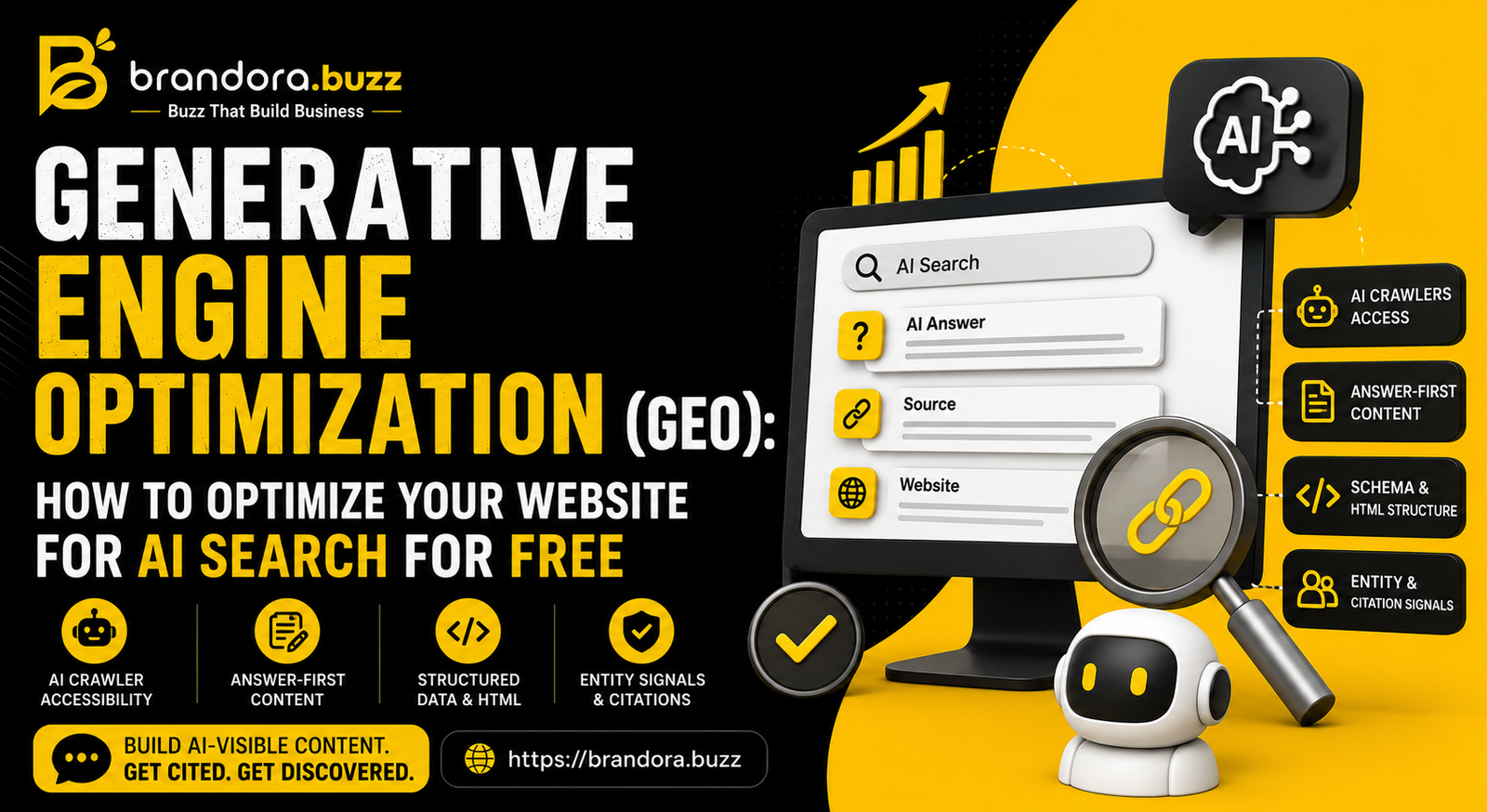
Traditional SEO was built around a simple objective:
Rank a webpage, earn a click, and convert the visitor.
Generative Engine Optimization (GEO) adds a new layer to that process.
When a user asks ChatGPT, Perplexity, Claude, or an AI-powered search engine a question, the system may not simply return ten blue links. It may:
- Interpret the question.
- Retrieve information from multiple sources.
- Extract relevant passages.
- Compare claims.
- Generate a synthesized answer.
- Cite or link to selected sources.
That changes what it means to be visible.
A website can rank well traditionally but still be poorly suited to AI retrieval. Conversely, a smaller website with highly specific, well-structured, easily extractable information may become a useful source for an AI-generated answer.
The objective of GEO is therefore not to “hack” an AI model.
It is to make your website:
- Easy to crawl
- Easy to understand
- Easy to extract information from
- Easy to associate with a real-world entity
- Easy to cite accurately
Traditional SEO optimizes pages for ranking. GEO optimizes information for retrieval, interpretation, and citation.
This distinction is increasingly important as search interfaces move from lists of links toward synthesized answers. Research into AI Overviews and generative search has found that AI-generated results can retrieve substantially different sources from traditional Google Search, making visibility in traditional rankings an imperfect proxy for visibility in AI answers.
The good news is that most of the foundational work required for AI Search optimization is free.
You do not need an expensive GEO platform.
You need a technically accessible website, clearly structured information, accurate entity signals, and content that gives answer engines something precise to retrieve.
1. The Shift from Blue Links to Answers
Traditional SEO: Rank → Click → Read
Traditional SEO generally focuses on:
- Keyword targeting
- Search intent
- Rankings
- Click-through rate
- Organic traffic
- Conversions
A page might target:
best accounting software for small businesses
The traditional goal is to rank for that query and persuade the searcher to click.
AI Search: Retrieve → Understand → Summarize → Cite
A generative search system may instead process a question such as:
“What is the best accounting software for a five-person consulting business with a limited budget?”
The system may need to identify:
- The user’s business size
- Industry
- Budget
- Required features
- Relevant product options
- Supporting evidence
The final answer may be generated from several retrieved sources.
This creates a different optimization challenge.
Your page must contain information that is:
- Specific enough to match a precise question
- Clear enough to be extracted
- Self-contained enough to summarize
- Trustworthy enough to cite
Keyword density is not information density
Keyword density asks:
“How often does this phrase appear?”
Information density asks:
“How much useful, verifiable information does this section communicate with minimal ambiguity?”
For example, this is weak:
“Our SEO services help businesses grow online with powerful strategies and expert solutions.”
This is more information-dense:
“Our local SEO process focuses on Google Business Profile optimization, service-area landing pages, review acquisition, technical SEO, and internal linking to improve visibility for location-based searches.”
The second sentence gives an answer engine more extractable facts.
Citation placement matters
If a page contains its most important answer in a vague paragraph buried beneath 2,000 words of introduction, an AI system has more work to do.
If the answer appears immediately beneath a descriptive heading in a concise, self-contained block, retrieval becomes easier.
The practical GEO principle: put the answer where a retrieval system expects to find it.
2. The GEO Comparison Matrix
| Optimization Factor | Outdated SEO Approach | 2026 AI Search Standard |
|---|---|---|
| Crawler Access | Allow Googlebot and ignore AI crawlers | Audit access for relevant search and AI crawlers |
| Content Formatting | Long paragraphs built around keyword repetition | Question-led headings followed by concise answer blocks |
| HTML Structure | Visually attractive but semantically vague div-heavy layouts | Native headings, paragraphs, lists, tables, and semantic elements |
| Information Architecture | One broad page targeting many loosely related keywords | Clearly separated entities, topics, services, and use cases |
| Schema | Add markup only for rich-result eligibility | Use accurate structured data to clarify entities and relationships |
| Brand Signals | Focus only on website backlinks | Build consistent entity references across trusted third-party platforms |
| Content Strategy | Publish high volumes of generic articles | Publish specific, original, information-dense answers |
| Internal Linking | Link using “click here” | Connect related entities and concepts with descriptive anchor text |
| Authority | Count backlinks only | Combine expertise, consistency, citations, references, and corroboration |
| Technical Delivery | Depend heavily on client-side rendering | Ensure important content is available in crawlable HTML |
| Measurement | Track rankings and organic clicks only | Track rankings, brand mentions, AI referrals, citations, and entity visibility |
The most important shift is this:
Do not ask only, “Can Google rank this page?” Ask, “Can an AI system confidently extract and attribute a useful answer from this page?”
3. The Four Free Pillars of AI Search Optimization
Pillar 1: Make Your Website Accessible to AI Search Crawlers
The first GEO requirement is basic:
If a relevant crawler cannot access your content, it cannot reliably retrieve your content.
Your first free audit should be your robots.txt file.
Visit:
https://yourdomain.com/robots.txtLook for overly broad rules such as:
User-agent: *
Disallow: /
That blocks all crawlers from the entire site.
Also check for specific bot rules that unintentionally block AI search crawlers.
OpenAI states that websites wanting their content included in ChatGPT search summaries and snippets should ensure they are not blocking OAI-SearchBot. Perplexity similarly documents PerplexityBot as the crawler used to surface and link websites in Perplexity search.
A basic example might look like:
User-agent: *
Disallow: /wp-admin/
Allow: /wp-admin/admin-ajax.php

User-agent: OAI-SearchBot
Allow: /

User-agent: PerplexityBot
Allow: /

Sitemap: https://example.com/sitemap.xml
However, do not blindly copy a robots file.
Your exact configuration should reflect your privacy, licensing, security, and content-access decisions.
Search access and AI training are not identical
This distinction is important.
OpenAI documents separate crawler controls for search and model-training use cases. Google also documents Google-Extended as a robots.txt control token for managing certain uses of content for Gemini-related training and grounding.
Therefore, do not assume:
“Allowing AI SearchBot” = “Allowing every possible AI use of my content.”
Audit the specific crawler and policy relevant to your objective.
Check more than robots.txt
A crawler can be technically allowed and still fail to access your content because of:
- HTTP 403 errors
- WAF rules
- CDN bot protection
- Login requirements
- CAPTCHA challenges
- Geo-blocking
- Rate limits
- JavaScript-only rendering
OpenAI specifically notes that web protection systems can mistakenly block legitimate crawlers and recommends checking infrastructure layers beyond robots.txt when access fails.
Static HTML is still strategically valuable
Your most important information should be available in the initial HTML whenever possible.
Avoid hiding critical information exclusively inside:
- Client-side JavaScript
- Interactive tabs that never render content
- Canvas elements
- Image-only graphics
- Content loaded only after multiple user actions
JavaScript is not automatically bad.
But if your answer is:
“The page loads a blank shell, then JavaScript requests the actual content from an API”
you have created more technical complexity for crawlers and retrieval systems.
A simple HTML structure is often more robust:
<h2>What does local SEO include?</h2>

<p>
Local SEO includes Google Business Profile optimization, local landing pages,
review generation, citation consistency, technical SEO, and location-based
content designed to improve visibility in local search.
</p>
Pillar 2: Use Answer-First Content and Information Density
One of the most practical GEO changes you can make is changing how your content begins.
Traditional content often looks like this:
H2: What Is Local SEO?

Paragraph 1: In today's competitive digital landscape...

Paragraph 2: Businesses are increasingly looking for...

Paragraph 3: Search engines have evolved...

Paragraph 4: Finally, the answer...
An answer-first structure looks like this:
H2: What Is Local SEO?

Local SEO is the process of improving a business's visibility in
location-based search results through Google Business Profile optimization,
local content, reviews, citations, technical SEO, and location relevance.
Then you can provide the detailed explanation below.
This is often called BLUF: Bottom Line Up Front.
The reader gets the answer immediately.
The retrieval system also gets a clean candidate passage.
Turn headings into real questions
Instead of:
H2: Local SEO BenefitsTry:
H2: What Are the Main Benefits of Local SEO?Instead of:
H2: Schema ImplementationTry:
H2: How Does Schema Markup Help Search Engines Understand a Business?Instead of:
H2: Google Business Profile OptimizationTry:
H2: How Do You Optimize a Google Business Profile?This structure mirrors how people actually ask questions.
Create 40–60 word answer blocks
Immediately below the question heading, provide a self-contained summary.
For example:
How Do You Optimize a Google Business Profile?
A Google Business Profile is optimized by using the correct business category, maintaining accurate name-address-phone information, adding complete services and business details, uploading relevant photos, publishing regular updates, and earning genuine customer reviews. The profile should accurately represent the real-world business and remain consistent with information published elsewhere online.
That paragraph can be understood independently.
It does not require the reader to consume five paragraphs before discovering the answer.
What is Information Gain?
Information gain is the amount of new, useful knowledge a piece of content contributes beyond what is already commonly available.
A generic sentence:
“SEO is important for businesses.”
provides almost no information gain.
A more specific statement:
“For a local service business, the highest-leverage free SEO sequence is usually to correct business information, optimize the Google Business Profile, build dedicated service-location pages, earn consistent reviews, and connect supporting content through internal links.”
provides a process.
It gives the reader something they can act on.
Add original information wherever possible
AI systems have access to enormous amounts of repetitive content.
Your opportunity is not to rewrite the same generic explanation found on 500 websites.
Add:
- Original data
- First-hand experience
- Process documentation
- Comparisons
- Examples
- Case studies
- Unique frameworks
- Specific limitations
- Clear recommendations
GEO rewards content that is not merely readable, but useful as evidence.
Pillar 3: Use Structured Data and Semantic HTML
AI systems do not rely only on schema markup.
However, structured data gives search engines an explicit machine-readable description of your page and entities.
Google describes structured data as a standardized format for providing information about a page and classifying its content. For LocalBusiness, it can communicate information such as business hours and other business details, provided the markup is accurate and follows guidelines.
Use the right schema for the right content
Common examples include:
Articlefor editorial contentLocalBusinessfor local business entitiesOrganizationfor organizationsProductfor productsFAQPagewhere appropriateBreadcrumbListfor page hierarchy
A basic Article example:
<script type="application/ld+json">
{
  "@context": "https://schema.org",
  "@type": "Article",
  "headline": "Generative Engine Optimization: How to Optimize Your Website for AI Search",
  "author": {
    "@type": "Person",
    "name": "Author Name"
  },
  "publisher": {
    "@type": "Organization",
    "name": "Example Brand"
  }
}
</script>
For a local business:
<script type="application/ld+json">
{
  "@context": "https://schema.org",
  "@type": "LocalBusiness",
  "name": "Example Business",
  "url": "https://example.com/",
  "telephone": "+1-555-123-4567",
  "address": {
    "@type": "PostalAddress",
    "streetAddress": "123 Main Street",
    "addressLocality": "Austin",
    "addressRegion": "TX",
    "postalCode": "78701",
    "addressCountry": "US"
  }
}
</script>
Important: Schema is not a ranking shortcut
Do not add schema because you believe it guarantees an AI citation.
Schema is a communication layer.
It helps machines understand:
“This is an article.”
“This is the author.”
“This is the organization.”
“This is the local business.”
But the data must be accurate and consistent with the visible page.
Google recommends validating structured data and ensuring that pages are accessible to crawlers and are not blocked by robots.txt, noindex, or login requirements.
Use semantic HTML
Do not build every element as:
<div class="heading">What is GEO?</div>Use:
<h2>What Is GEO?</h2>Use native elements where possible:
<p>...</p>
<ul>
  <li>...</li>
</ul>
And for structured comparisons:
<table>
  <thead>
    <tr>
      <th>Factor</th>
      <th>Traditional SEO</th>
      <th>GEO</th>
    </tr>
  </thead>
  <tbody>
    <tr>
      <td>Primary Goal</td>
      <td>Earn clicks</td>
      <td>Earn retrieval and citation</td>
    </tr>
  </tbody>
</table>
A native HTML table is generally more machine-readable than a visual table built entirely from nested div elements.
Pillar 4: Build an Entity Footprint and Citation Signals
AI systems need to understand not only what your website says, but also what entity your website represents.
Suppose your website claims:
“We are the leading digital marketing agency in a city.”
That claim becomes more credible when your business is consistently represented across independent sources.
Build a free entity footprint using relevant profiles such as:
- Google Business Profile
- Bing Places
- LinkedIn Company Page
- Industry associations
- Chamber of commerce directories
- Relevant professional directories
- Crunchbase, where appropriate for eligible companies
- Social profiles
- Author profiles
The goal is consistency.
Your:
- Brand name
- Website
- Business description
- Location
- Category
- Founders
- Services
should not contradict one another.
Think in entities, not just keywords
A search engine sees:
“Brandora digital marketing agency”
An AI system may need to understand:
- What is Brandora?
- Is it a company?
- What does it do?
- Where does it operate?
- Who founded it?
- What services does it provide?
- Which websites independently reference it?
That is entity understanding.
Create corroboration
If your website says:
“Brandora provides SEO, paid advertising, website development, and social media marketing.”
Your other legitimate profiles should describe the business consistently.
This does not mean copying the same paragraph everywhere.
It means avoiding contradictions.
For example:
Website: Digital marketing agency
LinkedIn: Software development company
Business directory: Advertising agency
These may all be technically related, but inconsistent categorization can make entity interpretation less clear.
Your brand should be recognizable as the same entity across the web.
4. The Four-Step GEO Implementation Sequence
Step 1: Audit Crawl Access
Start with:
yourdomain.com/robots.txtCheck:
- Is the whole site blocked?
- Are important directories disallowed?
- Is
OAI-SearchBotblocked? - Is
PerplexityBotblocked? - Are important pages behind login?
- Does the server return 403 or 429 errors?
- Does a CDN or WAF block legitimate crawlers?
Also check your important pages manually.
The goal is not to allow every bot automatically.
The goal is to make a deliberate decision about which crawlers can access which content.
Step 2: Reformat Your Best Pages into Answer Blocks
Do not rewrite your entire website immediately.
Start with your:
- Top 10 blog posts
- Highest-value service pages
- Most important product pages
- Local landing pages
For each page:
Identify the main questions
Use:
- Search Console queries
- Google autocomplete
- People Also Ask
- Customer questions
- Sales conversations
- Support tickets
Then restructure the page:
H2: Direct Question

40–60 word answer block.

Detailed explanation.

Examples.

Evidence.

Internal links.
Repeat this structure for the major subtopics.
Remove unnecessary introductions
Do not make the reader scroll through five paragraphs of scene-setting before answering the question.
Lead with the answer.
Then add depth.
Step 3: Add Accurate Schema and Semantic Markup
For each page:
- Identify the primary content type.
- Add appropriate JSON-LD.
- Use correct properties.
- Match visible page content.
- Validate the markup.
- Check for conflicting schema.
Then review your HTML.
Ask:
- Is there one clear H1?
- Are headings hierarchical?
- Are lists actual
<ul>or<ol>elements? - Are tables actual
<table>elements? - Are important facts present as text?
- Is critical content hidden behind JavaScript?
Step 4: Verify Entity Consistency
Create a simple spreadsheet with columns for:
| Platform | Brand Name | Website | Description | Category | Location |
|---|
Audit your:
- Google Business Profile
- Bing Places
- Social profiles
- Industry directories
- Author pages
- Company databases
Correct major contradictions.
Then build genuine third-party references over time.
Do not create hundreds of low-quality profiles simply to manufacture mentions.
One accurate, trusted profile is generally more useful than dozens of spammy listings.
5. The Free GEO Audit Checklist
Copy and paste this checklist into your SEO workflow.
Crawler Accessibility
robots.txtis accessible- Important pages are not accidentally blocked
OAI-SearchBotaccess has been deliberately reviewedPerplexityBotaccess has been deliberately reviewed- Relevant search crawlers are not blocked
- Important pages do not require login
- WAF/CDN is not returning accidental 403 errors
- Important content is not hidden exclusively behind JavaScript
- Important pages return successful HTTP responses
Answer-First Content
- Each major section answers a real question
- H2 and H3 headings are specific
- The direct answer appears immediately below the heading
- Summary blocks are self-contained
- Important facts are easy to extract
- Generic introductions have been reduced
- Content contains original information gain
- Claims are supported by evidence where appropriate
HTML and Schema
- One clear H1 exists
- Heading hierarchy is logical
- Lists use native HTML list elements
- Tables use native HTML table elements
- Article schema is accurate where applicable
- LocalBusiness schema is accurate where applicable
- FAQPage schema is used only where appropriate and accurately reflects visible content
- Structured data matches visible page content
- Schema has been validated
Entity Signals
- Brand name is consistent across profiles
- Website URL is consistent
- Business category is consistent
- Location information is accurate
- Founder or author information is consistent
- Google Business Profile is complete where applicable
- Bing Places is claimed where applicable
- LinkedIn company information is accurate
- Relevant industry profiles are complete
- No major contradictions exist across third-party sources
Citation Readiness
- The page makes clear, specific claims
- Important answers are easy to quote or summarize
- Key facts are not buried
- Sources are cited where appropriate
- Original insights are clearly distinguished
- Internal links explain topic relationships
- The page clearly identifies the business, author, or organization behind the information
Conclusion: GEO Is Technical Clarity at Scale
Generative Engine Optimization is not about inserting the phrase:
“AI search optimization”
into every paragraph.
It is about reducing ambiguity.
A search engine or AI system should be able to determine:
- Who created this information?
- What exactly is being discussed?
- What question does this section answer?
- Which facts are important?
- Which entities are connected?
- Can this information be trusted?
- Can the answer be cited accurately?
The free GEO strategy is therefore straightforward:
Make your content crawlable. Make your answers extractable. Make your structure semantic. Make your entities consistent.
Start with your robots.txt.
Then reformat your most valuable pages into answer-first sections.
Add accurate schema.
Use real HTML elements.
Build consistent brand profiles.
Publish original information with genuine information gain.
No paid GEO platform can compensate for a website that blocks relevant crawlers, hides its answers inside complex interfaces, uses ambiguous headings, and presents contradictory business information across the web.
The websites most prepared for AI Search will not necessarily be the ones with the most content.
They will be the ones whose information is easiest for machines to:
find, understand, verify, summarize, and cite.
